
American Primary Elections

Assessing A Unique Electoral Engine
Since we are currently in the thick of primary election season, it is difficult to step back from daily headlines to analyze a bigger picture. But we should. The primary election process has a profound significance on the current state of the American political system.
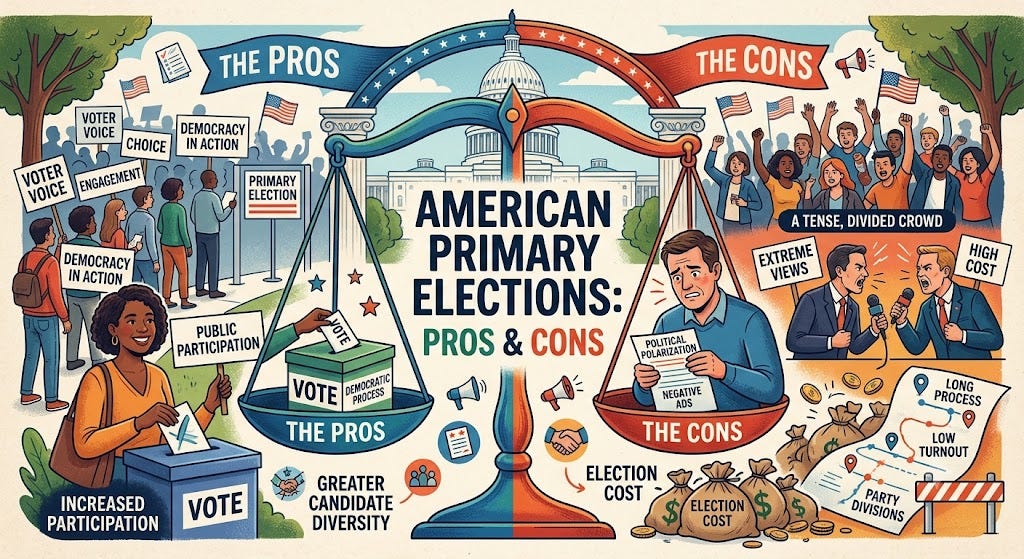
To understand how we got here, a bit of history is useful. Primary elections emerged as a fundamental reform of the Progressive Era. They were originally designed to democratize politics, moving candidate selection out of smoke-filled rooms controlled by party bosses and into the public square.
More than a century later, the system has evolved as a double-edged sword. It’s time for a look at the modern pros and cons of American primaries and some alternatives too..
Primary Pros
Despite flaws, the primary system serves several vital democratic functions:
Screens for Candidate Oversupply: It effectively winnows down a crowded field of contenders into a single choice for the general election.
Allows Intra-Party Competition: Incumbents can be challenged by members of their own party. This creates an internal check on elected officials who drift too far from their constituents’ current preferences, occasionally leading to high-profile upsets such as the 2026 Republican primary defeat of Senator John Cornyn in Texas or the Democratic Primary defeat of Representative Dan Goldman.
Trial Runs for the General Election: Primaries function as campaign stress tests. Successful candidates must build organizations, raise money, communicate an effective message and withstand scrutiny. Weaknesses exposed in a primary can be corrected; weaknesses exposed in the general election are often fatal.
Creates Voter Engagement in “Safe” Districts: Competitive primaries draw attention to races that might otherwise go unnoticed. Crucially, they give voters in heavily one-party districts a sometimes-meaningful choice, even if the general election is a foregone conclusion.
Reflect Ideological Diversity: Primaries allow the electorate to signal party leaders where public opinion currently stands, pulling nominees in directions the party establishment might not otherwise choose.
Democratic Legitimacy: A nominee who has won a public vote carries a democratic mandate that an appointee picked by party insiders lacks, lending greater legitimacy to the eventual winner.
Primary Cons
Despite the best Progressive-era intentions, primaries have not always worked as intended. Among the distortions that the current primary system has created within the American political system are:
· Low Turnout and the Rise of “Motivated Minorities”: A fundamental problem is that primary electorates are tiny and unrepresentative. Turnout in congressional and state primaries all-too-routinely falls between 10 and 20%. This self-selected slice of public activists skews older, whiter, more affluent and more ideologically extreme than the general electorate.
In “safe seats”, e.g., the vast majority of U.S. House districts due to gerrymandering and geographic sorting, winning the primary is winning the election. Winners are chosen by a relative few primary voters, leaving the system highly vulnerable to capture by single-issue groups, well-funded outside interests or fringe candidates with money or name recognition.
· Escalating Polarization and Litmus Tests: Because primary electorates are ideologically intense, candidates are incentivized to appeal to the activist base rather than the median voter. Republicans run right, Democrats run left, and the winners are ill-positioned to govern from the center or build cross-partisan coalitions. This produces “litmus test” politics, where a candidate’s viability depends on taking rigid, uncompromising positions on high-salience issues. While political scientists debate whether primaries cause polarization or merely reflect it, the threat of a primary challenge undeniably shapes incumbent behavior. Lawmakers frequently avoid compromise because of fear of being “primaried” in the next election cycle.
Primaries often punish the very qualities that make an effective legislator, e.g., a willingness to compromise, an ability to build across-the-aisle relationships or a record of pragmatic negotiation. This rewards ideological combativeness rather than governing competency.
· Financial Power: Primaries heavily reward fundraising capacity and name recognition. A candidate who can raise big dollars before the primary holds a big advantage, favoring wealthy self-funders and well-connected insiders over highly qualified but less-connected candidates. Furthermore, American campaigns are extraordinarily long and expensive by global standards. A looming competitive primary can consume a year or more of a incumbent’s time and force emphasis on fundraising and campaigning instead of governing.
· Voter Fatigue: The inundation of special interest money in primaries and the exhaustive timeline combine to produce a long pre-election saturation of the airwaves with campaign ads precisely at the time when few voters are paying attention. The inevitable result is voter fatigue.
The Mechanism Debate: Open vs. Closed Primaries
How a primary is organized drastically alters its democratic outcomes. The debate generally centers on several key trade-offs:
Voter Participation and the Independent Deficit: Open primaries generally produce much higher turnout because independents (who now make up more than 40% of the American electorate) can participate. Closed primaries concentrate participation strictly among registered party members, leading to smaller, more ideologically intense electorates and effectively locking many voters out of the most consequential part of many elections.
Party Control vs. Raiding Risks: Closed primaries give political parties stronger gatekeeping power over their own nominees. Open primaries dilute that control, allowing voters with no party loyalty to shape the platform. Critics of open primaries worry about strategic cross-party “raiding” where members of one party cross over to vote for a perceived weak candidate of the other party, despite the evidence that large-scale coordinated raiding is rare.
Ideological Moderation and Cohesion: Open primary advocates argue that including independents pulls nominees toward the political center. But data compiled by political scientists on this is inconclusive. Conversely, data do show convincingly that closed primaries tend to produce nominees tightly aligned with the core party platform, enhancing intra-party unity heading into the general election, despite the potential for legislative gridlock later.
Alternatives
The American primary system has not been widely copied globally. Most Western democracies vest candidate selection within party organizations rather than the public, treating parties as disciplined, programmatic organizations representing a segment of public opinion that allow voters to choose among competing parties. Unfortunately, that can lead to a widespread proliferation of political parties and potentially-unstable coalition governments when no party emerges with a majority.
The Progressives of a century ago had a still-valid democratic point about including the people in candidate selection. While American-style primaries have evolved as problematical, there may be ways to give the people a say in choosing candidates while avoiding some of the problems. Viable American alternatives to a flawed primary election system are gaining traction. Ranked Choice Voting (RCV) or nonpartisan, top-four open primaries can bypass many primary pitfalls, while encouraging broad voter participation and rewarding candidates who appeal to a wider, more moderate coalition of the electorate.
One of the most knowledgeable political writers--and thinkers--I've ever known. Not only does he describe the problems...he also comes up with solutions.